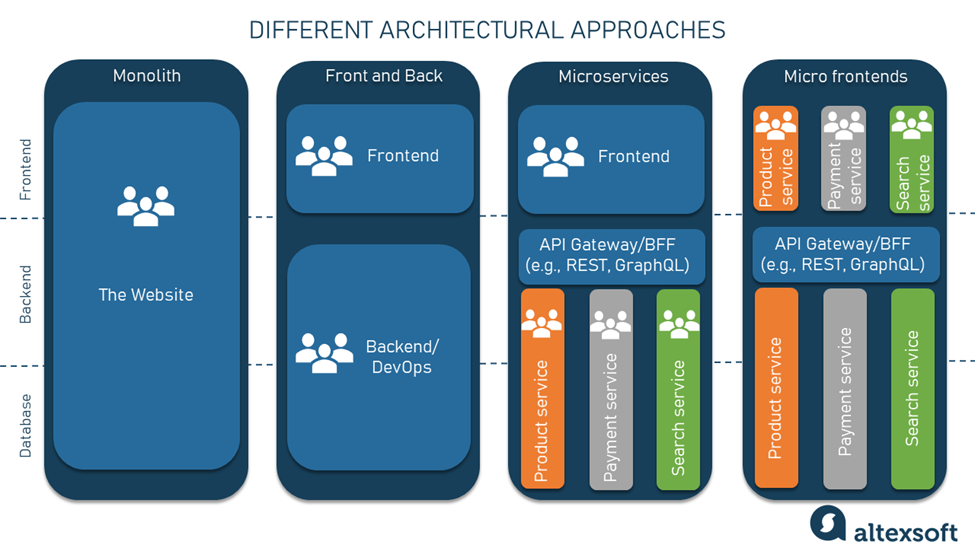
As technology advances and businesses become increasingly complex, front-end applications built from a single, monolithic resource are struggling to keep up with the growing demands of both businesses and customers.
This arises many issues since all front-end code is bundled into a single application, making it difficult to scale, maintain, and deploy. It also becomes challenging to implement changes or add new features to the application since all developers need to work on the same codebase.
All tech-based companies when talking about the idea of building an application that is scaling and easy to grow will come with these requirements:
This is when we apply Microservices approach to our front-end application by breaking everything down into smaller components so that each team in the project can work independently.
The idea behind Microfrontend is that no team owns the entire application UI. But every team has to take care of a small piece of front-end component. By breaking down the application into smaller components, Microfrontends simplify the development process, reduce dependencies between teams, and enable faster and more efficient deployment of updates and new features. Furthermore, because every team only takes care of a small part of the entire application so it is easier to deploy new features independently. This can reduce the risk of having a big issue and affect other parts of the application. This increases the application’s flexibility and improves feedback from customers.
While comes with many benefits, Microfrontend is not a silver bullet that solves all our problems of building a large frontend application. Some technical challenges we have to face when implementing Microfrontend applications included:
Consistency: Each team owns and develops its UI component. It is hard to keep up with every dependency version, framework, and technology in different bundles
A Monorepo is a single repository containing multiple distinct projects, with well-defined relationships. - monorepo.tools
The first thing that comes to your mind when reading the above definition of Monorepo is: “Why a monolith-like approach could solve the challenges of implementing Microfrontend?”
Turn out, A good Monorepo is the opposite of Monolithic. Let me explain clearer about this, let’s say that our familiar approach of Microfrontend is having multiple, small repositories that take care of small components. Which called these repo “polyrepo” as opposed to “monorepo”.
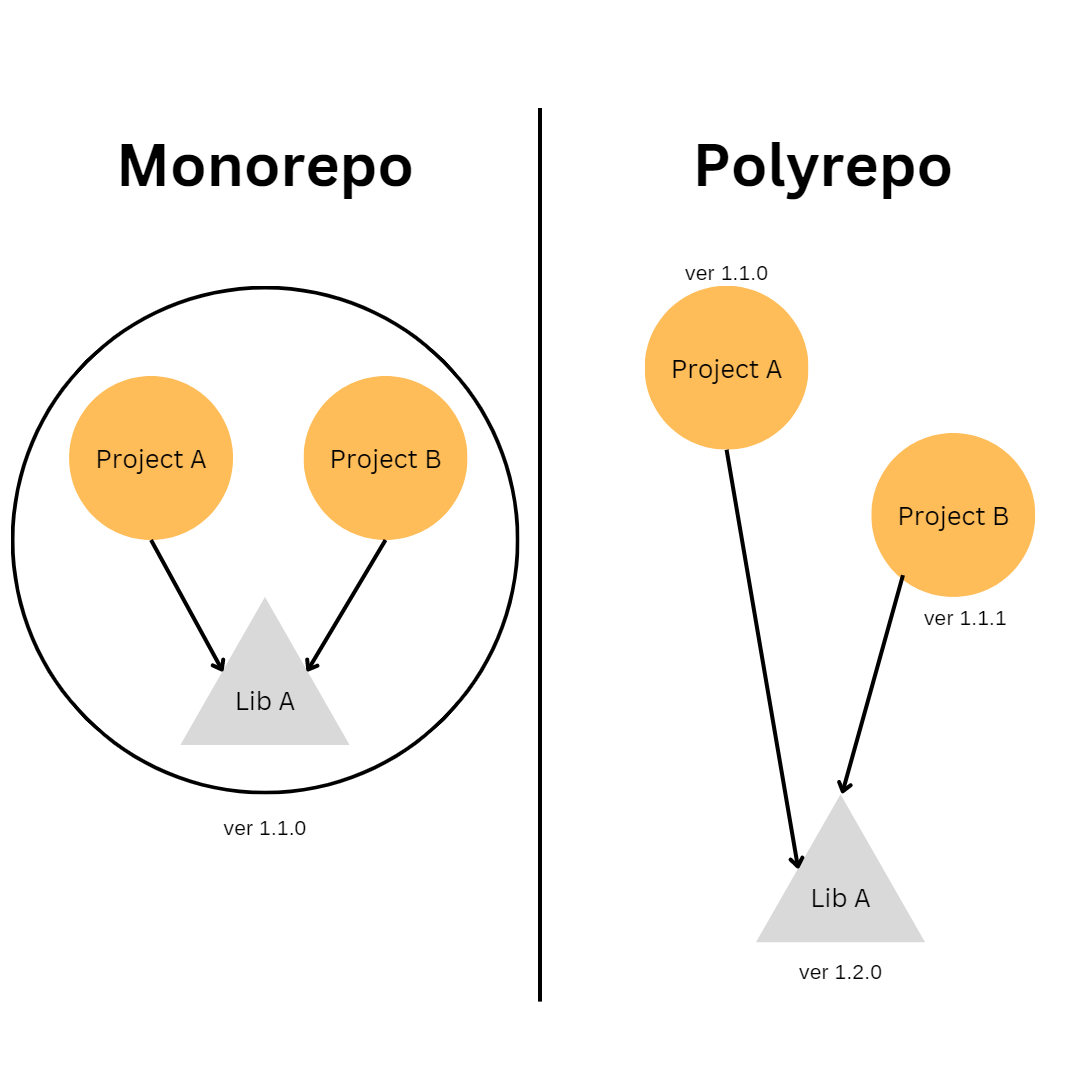
Since a Monorepo takes all projects into a single repository, here are some benefits that this way can help reduce the challenges of implementing Microfrontend application:
Although solving some challenges of Microfrontend architecture, Monorepo is not an easy approach. To work well with Monorepo, the developer teams should have these capabilities:
Large monolith front-end applications are considered limited in scalability and are transitioning to Microfrontend approach.
By having a Microfrontend architecture, enterprises have to deal with challenges like inconsistency dependency version, performance, and reusability.
One of the ways to solve issues of Microfrontend is based on Monorepo approach which acts as a centralized project with benefits like centralized dependencies, easy-to-manage version, and atomic developing process.
Original article published on MARCH 11, 2023 at https://junedang.com